Which Proxy Is Better for Ad Verification: Residential or Datacenter?
In this guide, we will break down where each proxy type fits, when residential IPs are worth the extra cost, and how to choose a setup that matches your ad verification process.



Ad verification only works when the environment looks close to a real user session. If your proxy setup is easy to detect, poorly targeted, or inconsistent across locations, your team can end up validating the wrong ad experience.
That is why many teams compare residential proxies vs datacenter proxies for ad verification before they scale a workflow. The right choice affects ad visibility, geo accuracy, block risk, cost, and the quality of the data you rely on.
In this guide, we will break down where each proxy type fits, when residential IPs are worth the extra cost, and how to choose a setup that matches your ad verification process.
What ad verification teams need from a proxy network
Ad verification is not just about loading a page through a different IP. In practice, teams usually need to answer questions like:
-
Is the ad showing in the correct country, city, or region?
-
Is the creative appearing as expected on the target site or app environment?
-
Are competitors or affiliates serving different ads by location?
-
Is ad delivery changing based on session behavior, ISP profile, or repeated requests?
-
Can the team collect validation data at scale without getting blocked too quickly?
A useful proxy network for ad verification should support:
-
Realistic browsing conditions so ad platforms are less likely to treat traffic as artificial
-
Geographic targeting at the country, and ideally city or ISP level when needed
-
Stable sessions for checks that require continuity across a browsing flow
-
Rotation options for broader sampling and repeated validation
-
Operational consistency for automated monitoring and reporting
This is where the difference between residential and datacenter proxies becomes important.
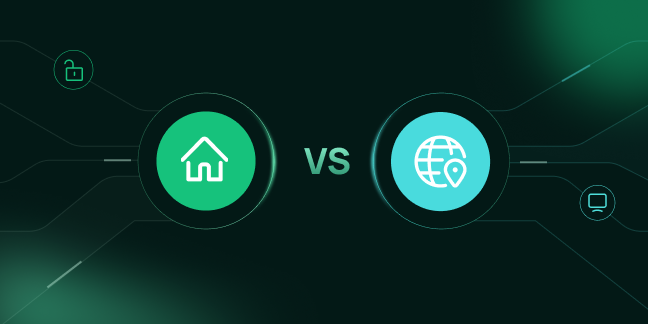
Residential proxies vs datacenter proxies for ad verification: core differences
At a high level, both proxy types route your traffic through another IP address. The difference is where that IP comes from and how platforms are likely to classify it.
Residential proxies
Residential proxies route traffic through IPs associated with real household devices and consumer internet connections. For ad verification, that often makes the traffic look more like typical end-user activity.
They are commonly used when teams need:
-
Better realism
-
Lower detection risk
-
Stronger geographic accuracy
-
More credible ad-view validation in user-like conditions
Datacenter proxies
Datacenter proxies come from cloud servers or hosting providers rather than consumer ISPs. They are often faster and cheaper, but they may be easier for platforms to identify as non-residential traffic.
They are commonly used when teams need:
-
Lower-cost large-scale requests
-
High speed for less sensitive tasks
-
Internal testing or broader checks where realism matters less
Quick comparison
|
Factor |
Residential proxies |
Datacenter proxies |
|
Traffic realism |
Higher |
Lower |
|
Detection risk in ad checks |
Usually lower |
Usually higher |
|
Geo credibility |
Stronger for local checks |
Can be limited depending on provider |
|
Cost |
Higher |
Lower |
|
Speed |
Often good, but varies |
Often faster |
|
Best fit |
Real-world ad verification |
Lower-sensitivity testing or bulk tasks |
Accuracy and detection risk: which proxy type better reflects real user conditions
For most ad verification workflows, accuracy depends on whether the ad server believes the request represents a normal user in the target location.
This is the main reason many teams prefer residential proxies.
If a platform sees repeated checks from known datacenter ranges, it may:
-
Serve a different ad experience
-
Limit the content shown
-
Trigger anti-bot controls
-
Withhold localized inventory
-
Distort the conditions you are trying to verify
That does not mean datacenter proxies are unusable. But in a datacenter vs residential proxy ad verification comparison, residential IPs usually perform better when the goal is to observe ads as real users would see them.
Residential proxies are especially useful when:
-
Campaigns are geo-targeted
-
Publishers or platforms apply stricter traffic filtering
-
You need to validate ad delivery across many real-world regions
-
The workflow involves repeated checks that would otherwise expose a narrow IP pool
Datacenter proxies may still work for:
-
Basic page-level availability checks
-
Internal QA before campaigns go live
-
Less sensitive monitoring where exact user realism is not the top priority
In short, if the question is best proxy type for ad verification, the answer often depends on how close your checks need to be to real consumer traffic. For high-confidence ad validation, residential proxies usually have the edge.
Geographic targeting and local ad checks
Location matters in ad verification because ad delivery often changes by:
-
Country
-
City or metro area
-
ISP or network type
-
Device and session profile
-
Language or regional campaign settings
If your team needs to verify whether a campaign appears correctly in Paris, Los Angeles, or São Paulo, the proxy network needs to support that level of targeting with enough realism.
Residential proxies are typically better suited for this because they are tied to consumer networks in actual regions. That helps when checking:
-
Localized retail promotions
-
Search ads in target markets
-
Region-specific competitor campaigns
-
Affiliate compliance across countries
-
Ad placements where city-level delivery matters
Datacenter proxies can support geographic testing too, but the result may be less representative if the IP ranges are recognized as hosting infrastructure.
For ad verification teams, geo accuracy is not just a technical detail. It directly affects whether the validation data reflects the campaign conditions you are trying to measure.
Cost, scale, and operational tradeoffs
The main argument for datacenter proxies is efficiency. They are often more affordable and can be easier to scale for high-volume requests.
That makes the tradeoff fairly straightforward:
Residential proxies
Pros
-
Better realism for ad delivery checks
-
Lower chance of obvious proxy classification
-
Stronger support for geo-specific verification
Cons
-
Higher cost per GB or session
-
More important to manage session strategy carefully
-
Not always necessary for every type of check
Datacenter proxies
Pros
-
Lower cost
-
Fast response times
-
Useful for broad, lower-risk automation tasks
Cons
-
Higher likelihood of detection in sensitive ad environments
-
Less representative of real-user browsing conditions
-
Can reduce confidence in localized ad validation
For many teams, the most practical ad verification proxy comparison is not all-or-nothing. A mixed setup can work well:
-
Use residential proxies for live campaign validation, geo checks, and sensitive publisher environments
-
Use datacenter proxies for internal QA, URL availability checks, and lower-stakes monitoring
That approach helps balance budget and reliability.
Static vs rotating proxies for ad checks
Beyond IP type, session behavior also matters. This is where static vs rotating proxies for ad checks becomes relevant.
Static sessions
A static session keeps the same IP for a longer period. This is useful when you need to:
-
Follow a multi-step browsing path
-
Reproduce a user session consistently
-
Validate landing page flow after the ad click
-
Perform manual checks with less session disruption
Rotating sessions
Rotating proxies change the IP at a defined interval or per request. This is useful when you need to:
-
Sample ad delivery across many users or regions
-
Reduce repeated-request concentration on a single IP
-
Run larger automated verification jobs
-
Expand coverage without overusing one session
Which one is better?
Neither is universally better. The right choice depends on the workflow:
-
Manual ad checks: static residential sessions are often more practical
-
Large-scale automated verification: rotating residential sessions are often better
-
Lower-sensitivity bulk checks: rotating datacenter proxies may be enough
Teams often make mistakes by choosing a proxy type but ignoring session behavior. In ad verification, IP source and session design both affect the quality of the result.
When to use residential proxies for ad verification
Residential proxies are usually the stronger choice when accuracy matters more than raw cost.
Use them when your team needs to:
-
Verify ads in real consumer-like conditions
-
Check campaigns across multiple countries or cities
-
Monitor placements on sites with stricter anti-bot filtering
-
Validate competitor, affiliate, or partner ad delivery with lower detection risk
-
Run recurring ad checks where repeated access from obvious proxy IPs would distort results
They are especially valuable for:
-
Growth teams auditing campaign delivery
-
Agencies validating paid media in local markets
-
Ecommerce brands checking shopping and display placements by region
-
Market intelligence teams comparing ad visibility across geographies
For these workflows, residential proxies often improve the credibility of the verification process because the traffic is closer to what ad systems expect from real users.
When datacenter proxies may be enough
Datacenter proxies can still be a practical option in narrower scenarios.
They may be enough when:
-
You are doing internal testing rather than production verification
-
You only need basic page retrieval or ad tag checks
-
The target environment has low detection sensitivity
-
Budget is the primary constraint and some realism tradeoff is acceptable
-
You want a lower-cost layer for preliminary screening before deeper validation
For example, a team might use datacenter proxies to confirm that campaign pages load and that tracking parameters are present, then switch to residential proxies for final geo-specific verification.
That is often a better decision than forcing one proxy type into every task.
How to choose the best proxy type for your ad verification workflow
If you are deciding between residential and datacenter proxies, use this framework.
Choose residential proxies if:
-
Real-user realism is critical
-
Your checks are geo-sensitive
-
You need better confidence in live ad visibility
-
The target sites or platforms are more detection-aware
-
False negatives from blocked or altered sessions would be costly
Choose datacenter proxies if:
-
The task is low sensitivity
-
You mainly need speed and cost efficiency
-
Exact user-like behavior is less important
-
The workflow is internal or preliminary
Consider a hybrid model if:
-
You have both QA and production verification needs
-
You want to control costs without weakening critical checks
-
Different campaign types require different levels of realism
A simple decision rule is this:
The more your ad verification depends on realistic location, session credibility, and lower detection risk, the more likely residential proxies are the better fit.
Common mistakes when selecting proxies for ad verification
Teams often get disappointing results not because proxies are unnecessary, but because the proxy strategy does not match the workflow.
Common mistakes include:
Choosing only by price
Cheaper proxies may look attractive at first, but if they reduce the realism of your checks, the data may be less useful.
Ignoring geographic requirements
If your campaign is city-specific, country-level targeting may not be enough.
Overlooking session behavior
A good IP pool alone does not solve everything. Static vs rotating session design affects how stable or broad your checks can be.
Using the same setup for every task
Production verification, internal QA, and bulk monitoring do not always need the same proxy type.
Treating access as the only success metric
Loading a page is not the same as validating a real ad experience. The key question is whether your setup reflects what the target audience would actually see.
Conclusion
The choice between residential proxies vs datacenter proxies for ad verification comes down to realism, geo accuracy, risk tolerance, and cost.
If your team needs reliable live-market validation, residential proxies are often the stronger option because they better support real-user conditions and location-sensitive ad checks. If your workflow is lower risk or more budget-driven, datacenter proxies may still be useful for limited tasks.
For many teams, the best answer is a workflow-based mix rather than a strict either-or decision.
If you are evaluating residential proxies for ad verification, TalorData can be worth reviewing for workflows that depend on geographic targeting, user-like access conditions, and repeatable validation across markets.
FAQ
Are residential proxies better than datacenter proxies for ad verification?
Often yes, especially when ad verification depends on realistic user conditions, local targeting, and lower detection risk. Datacenter proxies can still work for lower-sensitivity checks.
What is the best proxy type for ad verification?
The best proxy type for ad verification depends on the workflow. Residential proxies are usually better for live campaign checks and geo-targeted validation, while datacenter proxies may be enough for internal QA or basic monitoring.
Do I need static or rotating proxies for ad checks?
Use static sessions when you need continuity across a browsing flow. Use rotating sessions when you need broader coverage, repeated sampling, or larger-scale automation.
Can datacenter proxies work for geo-targeted ad verification?
They can, but the results may be less representative if platforms identify the traffic as coming from hosting infrastructure rather than real user networks.
Is a hybrid proxy setup useful for ad verification?
Yes. Many teams use datacenter proxies for lower-cost preliminary checks and residential proxies for high-confidence production verification.