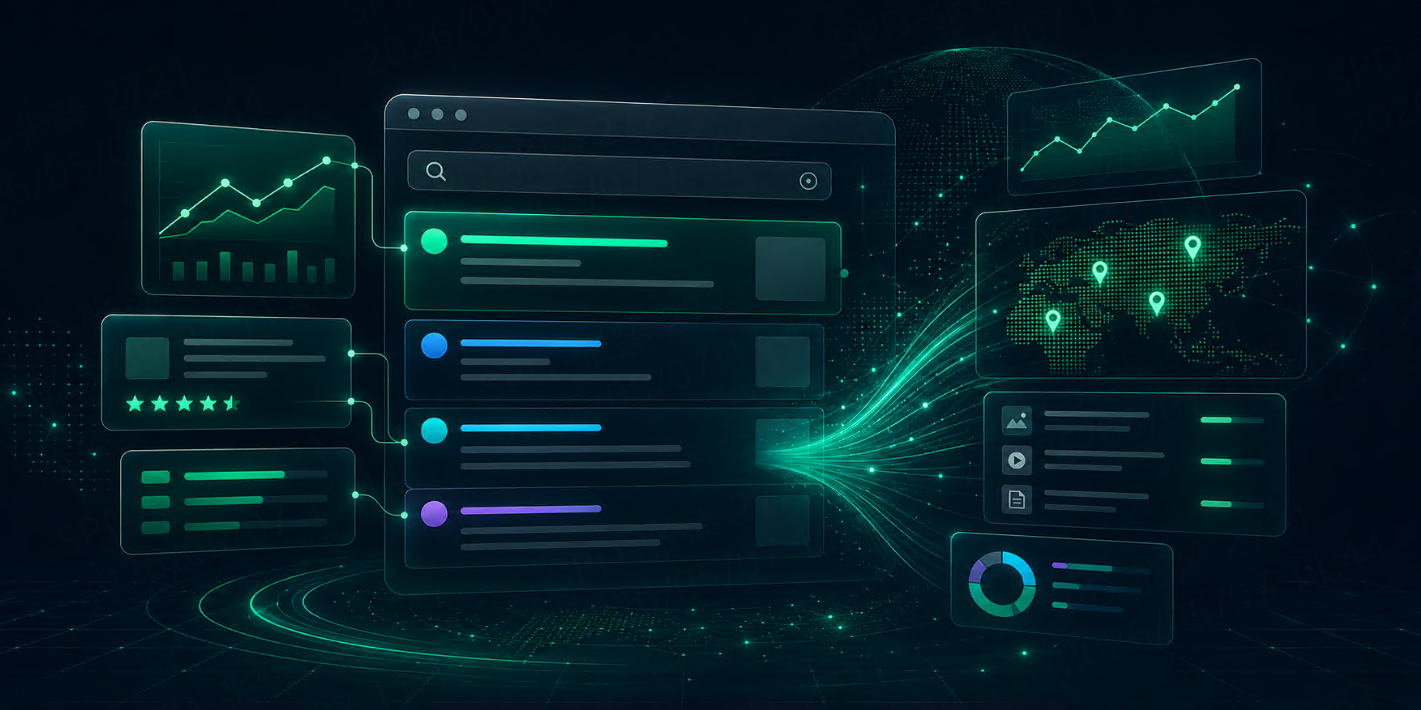
Google Local Pack API: How to Collect Local Business Results
Learn how to use a Google Local Pack API to collect local business results from Google Search. This guide covers Local Pack data fields, local keywords, location settings, rankings, ratings, reviews, websites, snapshots, local SEO, competitor tracking, AI workflows, and TalorData use cases.




When users search for local services on Google, they often see a group of business listings near the top of the search results page.
This section is commonly called the Google Local Pack.
For searches like “dentist near me,” “coffee shop in Austin,” “emergency plumber Chicago,” or “best Italian restaurant Brooklyn,” the Local Pack may show business names, ratings, review counts, addresses, websites, phone numbers, opening hours, and map-related links.
For users, it is a quick way to choose a local business.
For SEO teams, agencies, lead generation teams, market researchers, and AI products, it is a source of structured local business data.
That is where a Google Local Pack API becomes useful.
A Google Local Pack API helps collect local business results from Google Search and return them as structured data that can be stored, analyzed, compared, and used in applications.
A practical workflow looks like this:
Local keyword
↓
Target location
↓
Google Local Pack result collection
↓
Structured local business results
↓
Local SEO, competitor tracking, lead generation, market research, and AI workflows
This guide explains what a Google Local Pack API is, what data it can return, how to collect local business results, and how TalorData can support this workflow.
What Is the Google Local Pack?
The Google Local Pack is a local business result section that may appear in Google Search when the query has local intent.
A Local Pack usually includes several business listings and a map-style layout.
Common Local Pack searches include:
- dentist near me
- coffee shop in Austin
- plumber Chicago
- hotel near Central Park
- best sushi restaurant in Seattle
- car repair shop near me
- law firm in Dallas
A Local Pack result may show:
| Field | Description |
| Business name | The displayed name of the business |
| Ranking position | Where the business appears in the Local Pack |
| Rating | Average user rating |
| Review count | Number of reviews |
| Category | Business type, such as dentist, restaurant, hotel, or plumber |
| Address | Business address or location text |
| Phone number | Phone number shown in the result |
| Website | Business website link |
| Directions or map link | Link to map navigation or place result |
| Opening hours | Open status or displayed business hours |
| Image or thumbnail | Business image when available |
| Place identifier | Stable place-related identifier when available |
The Local Pack is important because it often appears above traditional organic results.
For local businesses, appearing in the Local Pack can be more valuable than ranking lower in organic results. Lovely, another reminder that “ranking number one” is not always as simple as humans wish it were.
What Is a Google Local Pack API?
A Google Local Pack API is an API workflow that collects Google Local Pack results and returns them in a structured format.
It is usually used to answer questions like:
- Which businesses appear for this local keyword?
- Which business ranks first in this city?
- Which competitors appear in the Local Pack?
- How many reviews does each business have?
- Which businesses have websites?
- Which businesses appear across multiple locations?
- How did Local Pack rankings change over time?
A simplified API request may look like this:
{
  "engine": "google",
  "q": "dentist near me",
  "location": "Austin, Texas, United States",
  "language": "en",
  "device": "mobile"
}
A simplified Local Pack result may look like this:
{
  "position": 1,
  "business_name": "Example Dental Clinic",
  "category": "Dentist",
  "rating": 4.8,
  "review_count": 326,
  "address": "123 Main Street, Austin, TX",
  "phone": "+1 512-000-0000",
  "website": "https://www.exampledental.com",
  "hours": "Open until 6 PM",
  "result_type": "local_pack"
}
Instead of manually searching Google and copying business listings one by one, teams can collect Local Pack results programmatically.
Google Local Pack API vs Google Maps API vs Places API
These terms are often confused, so it is worth separating them.
| API Type | Main Purpose | Best For |
| Google Local Pack API | Collect visible Local Pack results from Google Search | Local SEO tracking, competitor monitoring, SERP analysis |
| Google Maps API | Build map-based product experiences | Maps, routes, geocoding, map display |
| Places API | Retrieve place-related information for applications | Place search, place details, autocomplete |
| Business Profile API | Manage a business’s own Google Business Profile data | Profile management for owned businesses |
A Google Local Pack API focuses on what users see in Google Search for a local query.
That makes it useful for local visibility analysis, because it captures the competitive search result page, not just a single business record.
The simple distinction is:
Places API helps you work with place data.
Google Local Pack API helps you monitor local search visibility.
Tiny difference. Massive reporting consequences.
Why Collect Google Local Pack Results?
Local Pack data is useful because it shows the businesses Google displays for local intent searches.
Common use cases include:
| Use Case | What It Helps With |
| Local SEO tracking | Monitor whether a business appears in Local Pack results |
| Competitor monitoring | See which competitors rank for each local keyword |
| Agency reporting | Build local visibility reports for clients |
| Lead generation | Find local businesses by category, city, rating, and website status |
| Market research | Compare business density and competition across locations |
| Store expansion | Identify underserved or crowded local markets |
| Reputation analysis | Track ratings and review counts |
| AI agents | Give agents fresh local business context |
| RAG workflows | Collect local business sources for retrieval systems |
Local Pack data helps answer questions such as:
- Who ranks for “dentist near me” in Austin?
- Which restaurants dominate Brooklyn local results?
- Which plumbers appear across multiple neighborhoods?
- Which local businesses have high ratings but no website?
- Which competitors gained visibility this month?
- Which locations are crowded with similar businesses?
Without structured data, teams usually rely on manual searches and screenshots. The ancient ritual of “I checked it myself” continues to haunt civilization.
What Data Can a Google Local Pack API Return?
A good Local Pack API should return both search context and business result data.
Search Context Fields
| Field | Description |
| Keyword | The local query being searched |
| Country | Target country or market |
| Location | City, neighborhood, ZIP code, or coordinates |
| Language | Search language |
| Device | Desktop or mobile |
| Search engine | |
| Collection time | When the result was collected |
| Result type | Local Pack, map result, organic result, or another type |
Local Business Result Fields
| Field | Description |
| Position | Ranking order in the Local Pack |
| Business name | Displayed business name |
| Category | Business category |
| Rating | Average rating |
| Review count | Number of reviews |
| Address | Displayed address |
| Phone number | Displayed phone number |
| Website | Business website link |
| Opening hours | Open status or business hours |
| Map link | Link to the map or place result |
| Place identifier | Place-related identifier when available |
| Coordinates | Latitude and longitude when available |
| Image or thumbnail | Business image when available |
| Snippet | Visible description or related text |
If you want to monitor changes, always store the collection time. Without timestamps, you do not have monitoring. You have loose observations wearing a fake mustache.
Step 1: Choose Local Keywords
Start with local keywords that match the business category or service you want to analyze.
Useful keyword types include:
Service Keywords
- dentist near me
- emergency plumber
- roof repair company
- moving company near me
Category Keywords
- coffee shop
- Italian restaurant
- fitness center
- pet grooming
Location-Specific Keywords
- dentist in Austin
- coffee shop in Brooklyn
- plumber in Chicago
- hotel near Central Park
Commercial Local Keywords
- best dentist in Austin
- top-rated restaurant in Seattle
- affordable moving company Dallas
- best car repair shop near me
A simple keyword list may look like this:
dentist near me
dentist in Austin
best dentist in Austin
emergency dentist Austin
dental clinic Austin
Group keywords by category and intent.
| Category | Keyword | Intent |
| Dental clinic | dentist near me | Local service |
| Restaurant | Italian restaurant in Brooklyn | Local dining |
| Home service | emergency plumber Chicago | Urgent local service |
| Fitness | gym near me | Local service |
Start focused. A clean keyword set is more useful than a giant keyword dump pretending to be strategic.
Step 2: Choose Target Locations
Local Pack results depend heavily on location.
The same keyword can show different businesses in different cities, neighborhoods, ZIP codes, or coordinate points.
Common location levels include:
| Location Level | Examples |
| Country | United States, United Kingdom, Canada |
| State or region | California, Texas, Ontario |
| City | Austin, Chicago, Toronto |
| Neighborhood | Downtown Austin, Brooklyn Heights, SoHo |
| ZIP code | 94103, 10001, 60601 |
| Coordinates | Latitude and longitude |
| Location grid | Multiple coordinate points across a city |
For broad market research, city-level tracking may be enough.
For serious local SEO, coordinate-level tracking is often more useful because rankings can change across neighborhoods.
Example location setup:
| Keyword | Location | Device |
| coffee shop | Austin, Texas | Mobile |
| coffee shop | Downtown Austin | Mobile |
| coffee shop | Austin coordinate grid | Mobile |
The more local the search intent, the more precise your location settings should be.
Step 3: Collect Local Pack Results
Once you have keywords and locations, collect Google Local Pack results.
Example request:
{
  "engine": "google",
  "q": "coffee shop",
  "location": "Austin, Texas, United States",
  "language": "en",
  "device": "mobile"
}
Simplified response:
{
  "query": "coffee shop",
  "location": "Austin, Texas, United States",
  "local_pack_results": [
    {
      "position": 1,
      "business_name": "Example Coffee House",
      "category": "Coffee shop",
      "rating": 4.7,
      "review_count": 812,
      "address": "456 Market Street, Austin, TX",
      "phone": "+1 512-111-1111",
      "website": "https://www.examplecoffee.com",
      "hours": "Open until 8 PM"
    },
    {
      "position": 2,
      "business_name": "Downtown Brew",
      "category": "Coffee shop",
      "rating": 4.5,
      "review_count": 519,
      "address": "789 Congress Ave, Austin, TX",
      "phone": "+1 512-222-2222",
      "website": "https://www.downtownbrew.example",
      "hours": "Open until 7 PM"
    }
  ]
}
Collect the full Local Pack result set, not only the first business.
The full result set allows you to compare competitors, ratings, websites, review counts, and ranking changes.
Step 4: Store Results as Snapshots
Local Pack results change over time.
A business may move from position 5 to position 2. A competitor may disappear. A new business may enter the Local Pack. Ratings and review counts may change.
To monitor this, store snapshots.
A useful table structure includes:
| Column | Purpose |
| keyword | Local search query |
| keyword_group | Category or topic |
| country | Target country |
| location | City, neighborhood, ZIP code, or coordinate |
| language | Search language |
| device | Desktop or mobile |
| collected_at | Snapshot time |
| position | Local Pack ranking position |
| business_name | Displayed business name |
| category | Business type |
| rating | Average rating |
| review_count | Number of reviews |
| address | Displayed address |
| phone | Phone number |
| website | Business website |
| map_link | Map or place result link |
| place_id | Place identifier when available |
| latitude | Latitude |
| longitude | Longitude |
Snapshots allow you to compare:
- Today vs yesterday
- This week vs last week
- This month vs last month
- City A vs city B
- Neighborhood A vs neighborhood B
- Mobile vs desktop
- Business A vs business B
Without snapshots, you only know what is visible now. With snapshots, you can measure change.
Step 5: Normalize and Deduplicate Businesses
Local business data can contain variations.
The same business may appear as:
Example Coffee House
Example Coffee House Austin
Example Coffee House - Downtown
These may refer to the same business.
Useful normalization steps include:
| Step | What to Do |
| Normalize names | Remove unnecessary punctuation, suffixes, and casing differences |
| Normalize phone numbers | Convert phone numbers into one consistent format |
| Normalize addresses | Standardize street names and postal codes |
| Normalize websites | Remove tracking parameters and standardize domains |
| Deduplicate records | Use name, address, phone, website, place ID, and coordinates |
| Separate branches | Keep different physical locations separate |
This step is not glamorous. It is also where usable data is born. Naturally, the important part is the boring part. Humanity remains on brand.
Step 6: Analyze Local Pack Rankings
Once your data is clean, you can analyze local rankings.
Useful metrics include:
| Metric | Meaning |
| Current position | Where the business ranks now |
| Previous position | Where it ranked before |
| Position change | Whether ranking moved up or down |
| Top 3 presence | Whether the business appears in the most visible local positions |
| Local Pack presence | Whether the business appears at all |
| Keyword coverage | How many tracked keywords show the business |
| Location coverage | How many locations show the business |
| Competitor overlap | Which competitors appear for the same keywords |
Example ranking comparison:
| Business | Keyword | Location | Previous Position | Current Position | Change |
| Example Coffee House | coffee shop | Downtown Austin | 4 | 2 | Up 2 |
| Downtown Brew | coffee shop | Downtown Austin | 2 | 3 | Down 1 |
| City Roast | coffee shop | Downtown Austin | Not found | 5 | New |
This helps local SEO teams understand who is gaining and losing visibility.
Step 7: Analyze Ratings, Reviews, and Trust Signals
Local Pack results often include ratings and review counts.
These fields can help compare business trust signals.
Useful analysis includes:
| Analysis | What It Shows |
| Average rating by business | Customer satisfaction signal |
| Review count by business | Review volume and market presence |
| Rating change over time | Reputation trend |
| Review growth | Review acquisition speed |
| High rating, low ranking | Possible visibility opportunity |
| Low rating, high ranking | Strong visibility but weaker reputation |
| Competitor review gap | Difference between your business and competitors |
Example insights:
- A business with 4.9 stars and 35 reviews may have strong satisfaction but low review volume.
- A business with 4.4 stars and 2,000 reviews may have stronger market presence.
- A competitor with lower ratings but better ranking may have stronger proximity, relevance, website signals, or category fit.
Ratings do not explain everything, but ignoring them is equally foolish. Naturally, humans do both.
Step 8: Analyze Website and Contact Coverage
Local Pack results can also reveal whether businesses have websites and phone numbers.
Useful checks include:
- Does the business have a website?
- Does the business show a phone number?
- Is the website an official domain?
- Is the business using a third-party profile instead of its own website?
- Do multiple branches share the same website?
- Is the website outdated or missing HTTPS?
This helps with:
| Workflow | How Website and Contact Data Helps |
| Lead generation | Find businesses without websites |
| Local SEO sales | Identify businesses with weak local visibility |
| Market research | Measure digital maturity by category |
| Competitor analysis | See which competitors have stronger web presence |
| Agency prospecting | Build more relevant outreach lists |
Raw contact data should be verified before outreach. “Found it online” is not a compliance strategy, though many have bravely tried.
Step 9: Compare Local Pack Results Across Locations
Local Pack rankings can vary dramatically by location.
A business may rank well downtown but disappear in another neighborhood.
Useful comparison questions include:
- Which businesses dominate each city?
- Which businesses appear across multiple neighborhoods?
- Which locations have the strongest competition?
- Which areas have many low-rated businesses?
- Which areas have high demand but fewer visible providers?
- Which chains appear everywhere?
- Which independent businesses rank locally?
Example comparison:
| Keyword | Location | Top Local Pack Businesses |
| coffee shop | Downtown Austin | Example Coffee House, Downtown Brew, City Roast |
| coffee shop | South Austin | Southside Coffee, Example Coffee House, Local Bean |
| coffee shop | East Austin | East Brew, City Roast, Morning Cup |
This is useful for local SEO, store expansion, franchise planning, and competitive market analysis.
Step 10: Use Local Pack Data for Reports and Alerts
Local Pack data becomes more useful when turned into reports and alerts.
Useful report sections include:
| Report Section | What It Shows |
| Local visibility summary | Which businesses appear across keywords and locations |
| Ranking changes | Businesses that moved up or down |
| Competitor comparison | Who appears most often |
| Rating and review analysis | Trust signals by business |
| Website coverage | Which businesses have or lack websites |
| Location comparison | Visibility differences by city or neighborhood |
| New entrants | Businesses newly appearing in Local Pack results |
| Lost visibility | Businesses that disappeared from results |
Useful alerts include:
Example Coffee House dropped from position 2 to position 6 for “coffee shop” in Downtown Austin.
A new competitor entered the Local Pack for “dentist near me” in Austin.
A competitor gained 120 new reviews this month.
Your business disappeared from Local Pack results in South Austin.
Good alerts should be useful, not noisy. Nobody needs a system that screams every time a ranking sneezes.
Step 11: Use Local Pack Data for AI Workflows
AI agents and RAG systems can use Local Pack data as fresh local search context.
Useful AI workflows include:
| AI Workflow | How Local Pack Data Helps |
| Local market research | Summarize visible businesses by location |
| Business comparison | Compare ratings, reviews, websites, and locations |
| Lead scoring | Identify businesses that match target criteria |
| Local SEO assistant | Find competitor gaps and ranking changes |
| Store expansion research | Compare business density and competition |
| RAG source selection | Select business websites and local source URLs |
A safe AI workflow looks like this:
Collect Local Pack results.
Normalize business data.
Filter relevant businesses.
Verify important fields.
Select source URLs.
Use verified data in AI or RAG workflows.
Local Pack data should be treated as search context, not final truth. Business information can change. Verify important details before using them in sales, reports, or decisions.
How TalorData Helps Collect Google Local Pack Results
TalorData can act as the structured SERP data layer for collecting Google Local Pack results.
Instead of manually searching Google and copying local business listings, teams can use TalorData to collect structured results by keyword, country, language, location, and device.Try 1000 API Requests Now>>
A practical TalorData workflow looks like this:
Local keywords
↓
Target locations
↓
TalorData SERP API
↓
Structured Local Pack results
↓
Database, dashboard, CRM, AI agent, or SEO report
TalorData supports workflows such as:
| Workflow | What It Supports |
| Local SEO monitoring | Track Local Pack presence and rankings |
| Competitor tracking | See which businesses appear across keywords |
| Lead generation | Build local business lists by category and location |
| Agency reporting | Create repeatable local visibility reports |
| Market research | Compare ratings, reviews, and business density |
| Store expansion | Analyze local market conditions |
| AI agents | Provide fresh local business search context |
| RAG workflows | Select local source URLs for retrieval |
The value is repeatability. Teams can collect comparable Local Pack data over time, store snapshots, and measure local visibility changes instead of relying on manual searches and screenshots.
Final Thoughts
A Google Local Pack API helps teams collect local business results from Google Search in a structured and repeatable way.
It can support local SEO, competitor monitoring, lead generation, market research, agency reporting, store expansion, AI agents, and RAG workflows.
The basic process is simple:
Choose local keywords.
Choose target locations.
Collect Local Pack results.
Extract business fields.
Store snapshots.
Clean and normalize the data.
Analyze rankings, reviews, websites, competitors, and locations.
Build reports, alerts, lead lists, dashboards, or AI workflows.
Google Local Pack results show which businesses users can find.
Structured Local Pack data shows how that visibility changes, which competitors are winning, and where local opportunities exist.
FAQ
What is a Google Local Pack API?
A Google Local Pack API collects local business results from Google Search and returns structured data such as business names, rankings, ratings, reviews, addresses, websites, phone numbers, categories, and opening hours.
What is the Google Local Pack?
The Google Local Pack is a local business result section that may appear in Google Search when a query has local intent, such as “dentist near me” or “coffee shop in Austin.”
What can I use Local Pack data for?
Common use cases include local SEO tracking, competitor monitoring, lead generation, market research, agency reporting, store expansion, and AI workflows.
What fields should I collect from Local Pack results?
Start with keyword, location, country, language, device, timestamp, position, business name, category, rating, review count, address, phone number, website, map link, and result type.
Is Local Pack data useful for AI agents?
Yes. Local Pack data can help AI agents compare businesses, summarize local markets, select source URLs, and support local SEO or lead generation workflows.