6 Best Google SERP APIs in 2026
Looking for a Google SERP API? We benchmarked 7 leading providers in 2026 on pricing, free tier, and developer experience. Find the right fit.
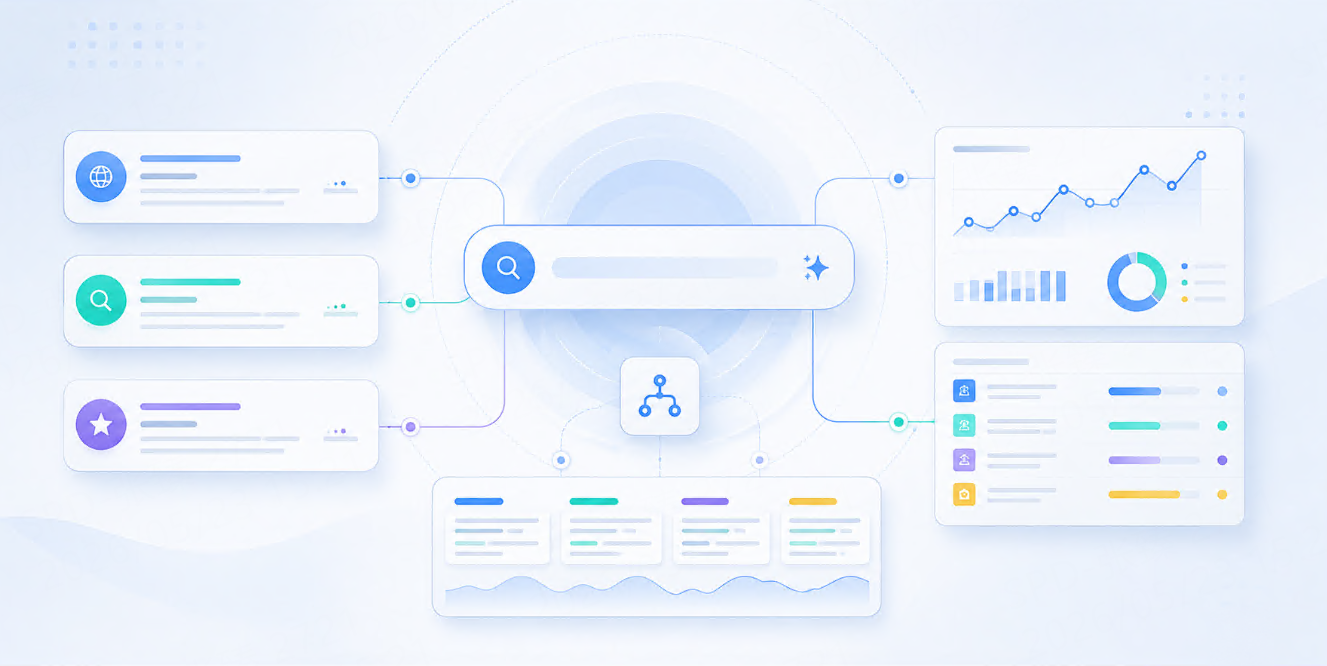



Modern SERPs include organic results, ads, featured snippets, People Also Ask, knowledge panels, maps, shopping results, news, videos, and increasingly AI-driven search experiences. For developers building SEO tools, rank trackers, AI agents, market research platforms, or competitive intelligence workflows, maintaining your own Google scraper can quickly become expensive and fragile.
A Google SERP API solves that problem by returning search result data in a structured format, usually JSON or HTML, without forcing your team to maintain proxies, browser automation, retry logic, parsing rules, and localization infrastructure.
This guide compares seven Google SERP APIs for developers in 2026. The focus is not only raw performance, but also developer experience, pricing model, SERP feature coverage, localization, output format, and practical use cases.
For a deeper performance-focused review, see our dedicated benchmark: SERP API Benchmark 2026.
Best Google SERP APIs in 2026
The best Google SERP API depends on what you are building. Here is the short version for developers and SEO product teams.
|
API |
Best For |
Starting Pricing Snapshot |
|
TalorData |
Cost-efficient Google SERP data for SEO and AI products |
1,000 free responses; paid plans from $1/1K responses, down to $0.25/1K at high volume |
|
SerpApi |
Broad Google vertical coverage and mature developer tooling |
Free plan with 250 searches/month; paid plans from $25/month |
|
DataForSEO |
SEO platforms, rank tracking, and bulk SERP data workflows |
From $0.0006 per SERP in Standard Queue; Live mode from $0.002 per SERP |
|
BrightData |
Enterprise-grade search data infrastructure |
Free tier with 5K requests/month; pay-as-you-go at $1.5/1K requests |
|
Oxylabs |
Large-scale scraping infrastructure and advanced SERP feature extraction |
Web Scraper API starts from $0.25/1K results |
|
Serper |
Simple, fast Google Search API for developers |
2,500 free queries; paid top-ups from $50 for 50K credits |
Prices and public features were checked on June 12, 2026. Always verify the latest pricing on each provider’s official website before purchase.
What Is a Google SERP API?
A Google SERP API is a developer interface that lets you retrieve Google search result pages programmatically. Instead of opening Google in a browser and scraping the HTML yourself, you send a query such as best running shoes, choose parameters like country, language, device, or result type, and receive structured search data.
A good SERP API should return more than organic links. For SEO and product teams, the most useful APIs also support ads, featured snippets, related questions, local packs, shopping results, news, images, videos, and raw HTML when needed.
How We Compared These SERP APIs
This comparison looks at factors developers usually care about before integrating a SERP API:
· Google SERP feature coverage
· JSON and HTML output options
· Localization by country, city, language, and device
· Pricing transparency
· Free trial or free tier availability
· Developer experience and documentation
· Use cases for SEO, AI agents, rank tracking, and competitive monitoring
This article is a buyer’s guide, not a full performance benchmark. For latency, success rate, and deeper testing methodology, read the full SERP API Benchmark 2026.
TalorData
TalorData SERP API is a strong option for developers who need structured Google search data with predictable pricing and a simple integration path. It supports Google, Bing, Yandex, and DuckDuckGo, and returns SERP data in JSON or HTML formats. TalorData is especially useful for SEO platforms, AI search workflows, rank monitoring, brand tracking, local SEO analysis, and e-commerce intelligence. The API is designed around real-time SERP data, geo-targeted queries, and pay-per-successful-request billing. Pricing is one of its clearest advantages. TalorData offers 1,000 free API responses on signup. Paid SERP API plans start at 5,000 responses for $5, or $1/1K responses, and scale down to $0.25/1K responses at the 10,000,000 response tier.
Best for: developers who want a cost-efficient Google SERP API with structured output, free trial credits, and flexible pricing.
Key strengths:
· JSON and HTML response formats
· Pay per successful request
· Google, Bing, Yandex, and DuckDuckGo support
· Geo-targeted SERP data
· Pricing down to $0.25/1K responses at high volume
· Good fit for SEO rank monitoring and AI search applications
Potential limitation: TalorData is still building broader market awareness compared with older SERP API brands, so developer teams may want to test coverage and response structure against their exact workflow.
SerpApi
SerpApi is one of the most established Google SERP API providers. It supports a wide range of Google surfaces, including Google Search, Images, News, Maps, Shopping, Trends, Jobs, Scholar, AI Overview, AI Mode, and many other search verticals. Its pricing page lists a free plan with 250 searches per month, then paid plans starting at $25/month for 1,000 searches. Larger standard plans include $75/month for 5,000 searches, $150/month for 15,000 searches, and $275/month for 30,000 searches.
Best for: teams that need wide Google vertical coverage and a mature API ecosystem.
Key strengths:
· Very broad Google endpoint coverage
· Multiple language integrations
· Free plan available
· Strong documentation and long-running developer presence
· Useful for AI, local SEO, product research, travel, and search apps
Potential limitation: For high-volume SERP collection, per-search pricing can become expensive compared with lower-cost providers.
DataForSEO
DataForSEO SERP API is built heavily around SEO software, rank tracking, keyword research, and competitive SERP analysis. It supports parsed JSON, raw HTML, and multiple search engines through one API ecosystem. DataForSEO offers several processing modes. Its public SERP API page lists Standard Queue pricing from $0.0006 per SERP, Priority Queue from $0.0012 per SERP, and Live Mode from $0.002 per SERP. Standard Queue is bulk-friendly, while Live Mode is better for real-time applications.
Best for: SEO platforms, rank tracking products, and teams that need bulk SERP collection.
Key strengths:
· Strong SEO product orientation
· Standard Queue, Priority Queue, and Live Mode options
· Google Organic, Images, News, Maps, AI Mode, and other endpoints
· Useful for rank tracking, keyword research, and SERP feature monitoring
· Pay-as-you-go model
Potential limitation: The pricing model is powerful but more complex than simple monthly or per-1K request pricing, so teams should model costs before integration.
BrightData
Bright Data SERP API is positioned as an enterprise-grade search data solution. It supports Google, Bing, DuckDuckGo, Yandex, Baidu, Yahoo, and Naver, with output formats including JSON, HTML, and Markdown. Bright Data’s public page lists a free tier with 5K requests per month, pay-as-you-go pricing at $1.5/1K requests, and a Scale plan at $499/month with 380K requests included. It also emphasizes successful-delivery billing, geo-targeting, full browser rendering, CAPTCHA solving, and enterprise support.
Best for: enterprise teams that want SERP data as part of a larger web data infrastructure.
Key strengths:
· Broad search engine coverage
· JSON, HTML, and Markdown output
· Free tier available
· Enterprise-grade infrastructure and support
· Strong geo-targeting and scraping infrastructure
Potential limitation: Bright Data can be more than some developers need if the use case is simply get Google results as JSON.
Oxylabs
Oxylabs SERP Scraper API is part of Oxylabs’ Web Scraper API platform. It is designed for real-time SERP extraction and supports Google SERP features such as organic results, ads, featured snippets, local packs, knowledge graph, top stories, popular products, AI Overviews, and AI Mode. Oxylabs publicly lists Web Scraper API pricing from $0.25/1K results and offers a free trial with up to 2K free results. Its SERP product page also highlights pay-only-for-successfully-delivered-results billing and support for continuous scroll.
Best for: teams that need scalable SERP scraping infrastructure with rich Google feature coverage.
Key strengths:
· Strong enterprise scraping infrastructure
· Wide Google SERP feature support
· AI Overview and AI Mode support
· Custom parsing options
· Scheduler and cloud delivery options
· Free trial available
Potential limitation: For smaller developer projects, the broader Web Scraper API platform may feel heavier than a focused Google SERP API.
Serper
Serper is a simple Google Search API focused on speed and affordability. Its homepage claims 1-2 second Google results and offers 2,500 free queries with no credit card required. Serper uses a top-up pricing model rather than a monthly subscription. Public pricing lists $50 for 50K credits, or $1.00/1K queries, with larger credit packages dropping to $0.75, $0.50, and $0.30 per 1K queries. It supports search, images, news, maps, places, videos, shopping, scholar, patents, and autocomplete.
Best for: developers who want a low-friction Google API with simple pricing.
Key strengths:
· Easy to start
· 2,500 free queries
· Real-time Google results
· Simple credit-based pricing
· Good fit for AI chatbots, SEO tools, and lightweight search apps
Potential limitation: Serper is Google-focused, so it may not be the best choice if you need deep multi-engine search coverage or enterprise web data features.
Google SERP API Use Cases for Developers
SEO rank tracking: Track keyword positions across countries, cities, languages, and devices.
SERP feature monitoring: Detect when featured snippets, People Also Ask, local packs, shopping units, or ads appear for target keywords.
Competitor monitoring: Track which competitors appear in organic results, paid placements, shopping results, and knowledge panels.
AI agents and RAG workflows: Give AI systems access to fresh search results instead of relying only on static training data.
Local SEO: Monitor map packs, local rankings, business listings, and geo-specific search visibility.
Market research: Analyze how search demand, SERP composition, and competitor visibility change over time.
Ad intelligence: Monitor paid search placements, ad copy, landing pages, and competitor campaign activity.
How to Choose the Right Google SERP API
· Choose TalorData if you want a cost-efficient SERP API with structured Google data, pay-per-successful-request billing, and pricing that scales down for high-volume usage.
· Choose SerpApi if you need one of the broadest sets of Google vertical APIs and mature developer documentation.
· Choose DataForSEO if you are building SEO software, rank tracking, or bulk SERP data pipelines and want queue-based pricing flexibility.
· Choose Bright Data if SERP data is only one part of a larger enterprise web data infrastructure.
· Choose Oxylabs if you need advanced scraping infrastructure, custom parsing, SERP feature coverage, and enterprise-scale delivery.
· Choose Serper if you want a fast, simple, Google-first API with a credit-based model.
Final Verdict
For most developers, the best Google SERP API is the one that matches the product you are building.
If your goal is SEO rank tracking, competitor monitoring, local SEO, or AI search workflows with predictable cost, TalorData SERP API is a strong place to start. It offers free trial responses, JSON/HTML output, multiple search engines, geo-targeted data, and pricing that becomes highly competitive at scale.
If your application needs many niche Google verticals, SerpApi is worth evaluating. If you are building SEO software with bulk queue-based processing, DataForSEO is a natural candidate. If you need enterprise scraping infrastructure beyond SERP data, Bright Data and Oxylabs are strong options. If you want quick Google-only integration, Serper is simple developer-friendly choices.
The practical recommendation: test two or three APIs with your real keywords, target countries, expected concurrency, and required SERP features before committing. SERP APIs can look similar on a pricing page, but the best one is the API that returns the data your product actually needs, in the format your developers can maintain.
FAQ
What is the best Google SERP API for developers?
The best Google SERP API depends on your use case. TalorData is strong for cost-efficient structured SERP data, SerpApi offers broad Google vertical coverage, DataForSEO is well suited for SEO platforms, and Bright Data or Oxylabs are better for enterprise web data infrastructure.
Is a SERP API better than scraping Google directly?
For most production applications, yes. A SERP API removes much of the infrastructure work around proxies, browser automation, retries, parsing, localization, and result normalization. Direct scraping may work for experiments, but it becomes difficult to maintain at scale.
Can I use a Google SERP API for SEO rank tracking?
Yes. SERP APIs are commonly used for rank tracking because they can return organic positions, paid results, SERP features, location-specific results, and device-specific results in structured formats.
Which Google SERP API is best for AI agents?
For AI agents and RAG workflows, look for real-time results, low latency, clean JSON output, and reliable query localization. TalorData, Serper, SerpApi, DataForSEO, Bright Data, and Oxylabs all have relevant use cases depending on the scale and data depth required.
How much does a Google SERP API cost?
Pricing varies widely. Some providers charge per search, some per 1,000 requests, and others use monthly plans or queue-based pricing. Public pricing in this guide ranges from free trial tiers to high-volume plans below $1/1K requests.
What data can I get from a Google SERP API?
Depending on the provider, you can retrieve organic results, ads, featured snippets, People Also Ask, related searches, knowledge panels, local packs, maps, shopping results, news, images, videos, AI Overviews, and raw HTML.
Are Google SERP APIs legal?
SERP APIs generally work with publicly available search result data, but legal and compliance requirements depend on your jurisdiction, use case, data handling, and applicable terms. Always review provider policies and your own compliance requirements before using SERP data in production.